PLAYBOOK
Live LED panels for trade shows, built with AI in one night
Want live LED panels for a trade show or conference booth? How AI turned a one-line request into a self-updating LED display in one evening — and how to get one.
Published September 2, 2026 · 6 min read · Joel Tokenman · Automation writer, Verikal
Short answer: yes — and you don’t need a big-brand budget to do it. A trade-show or conference LED panel is just a grid of pixels driven over HDMI, so you can make it show live, self-updating data by rendering a web page at the panel’s exact resolution and feeding it from something as simple as a Google Sheet. What used to take a team a week now takes an evening, because AI does the reading, spec-work, and coding in the loop. Here’s a real one: a one-line request — “make our booth’s LED header show how much cash we have left to buy cards, and change as we buy” — became a live, self-updating LED sign, designed and built in a single evening, starting from a PDF quote.
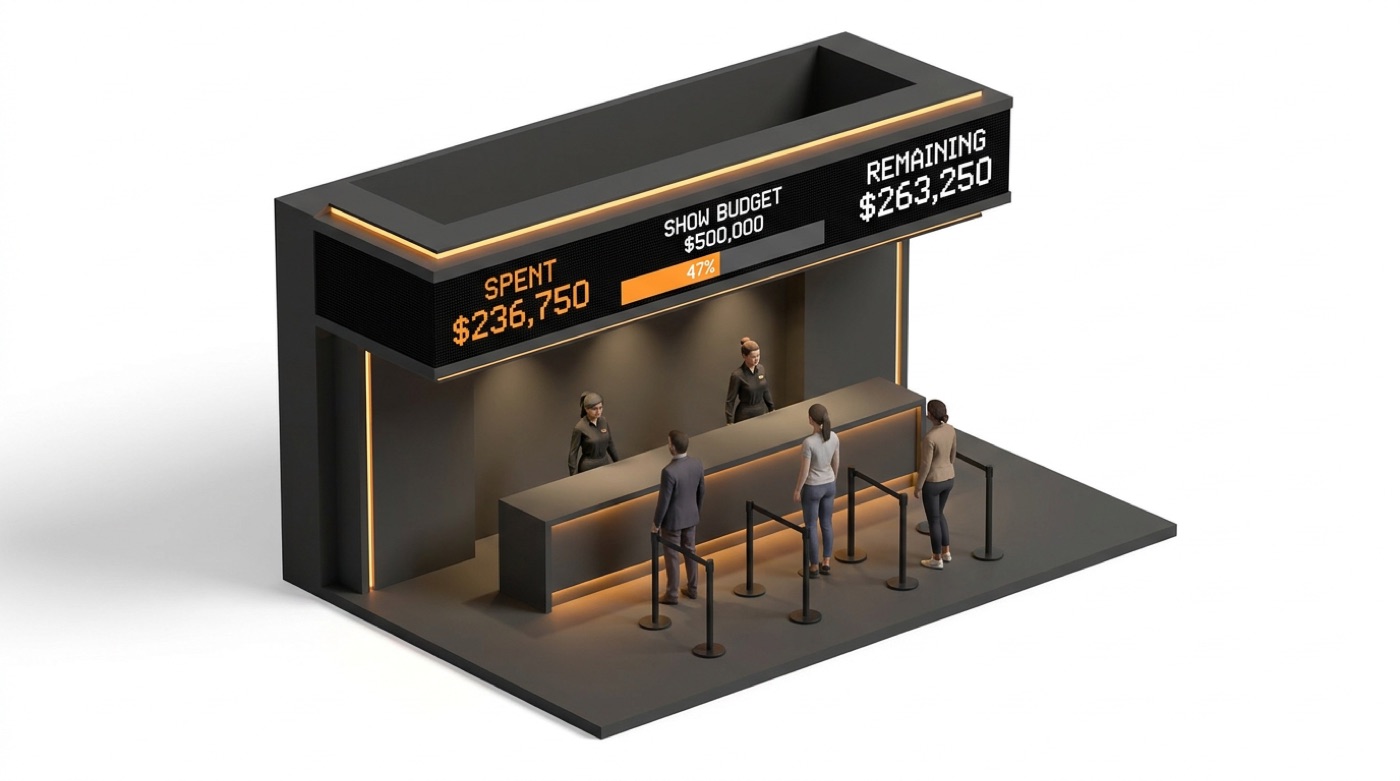
This post is the concrete version of “adding AI to your business”: not “AI is amazing,” but exactly what AI did, exactly what a human did, and what the business got.
Looking for live LED panels for a trade show or conference?
If you found this because you’re planning a stand and want an LED display for a conference booth that does more than loop a logo, that’s the whole point. The same approach works for a live sales counter, a leaderboard, a sponsor ticker, a countdown, a giveaway board — anything that should react to what’s happening on the floor. The build below is a “cash budget” wall, but the method is general, and AI is what makes it affordable for a small company. Skip to how to get one →
The request, in one line
A collectibles-buying company had a booth at a big show with a long LED header across the top. The owner said one sentence:
“The header should show how much cash we have left to buy cards, and change as we buy.”
No spec. No resolution. No data plan. In the old way, that’s a week of back-and-forth with a developer, a designer, and the LED vendor. With AI in the loop, it was one evening.
What did the AI actually do?
Not “chat.” It did the build work — reading, deriving, designing, coding, and packaging:
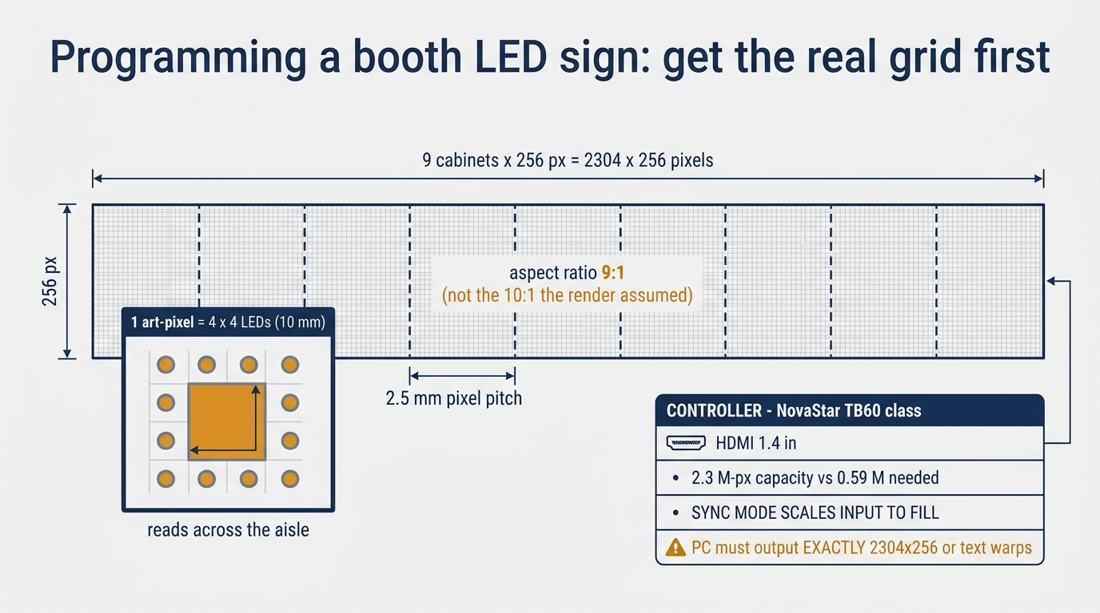
- Read the LED vendor’s PDF quote and the controller spec and derived the real pixel grid — 2304 × 256 from 9 cabinets at 2.5 mm — instead of trusting the booth render.
- Flagged the controller gotcha: the controller scales the HDMI input to fit the screen, so the booth PC must output that exact resolution or the text warps. Caught before anything was built.
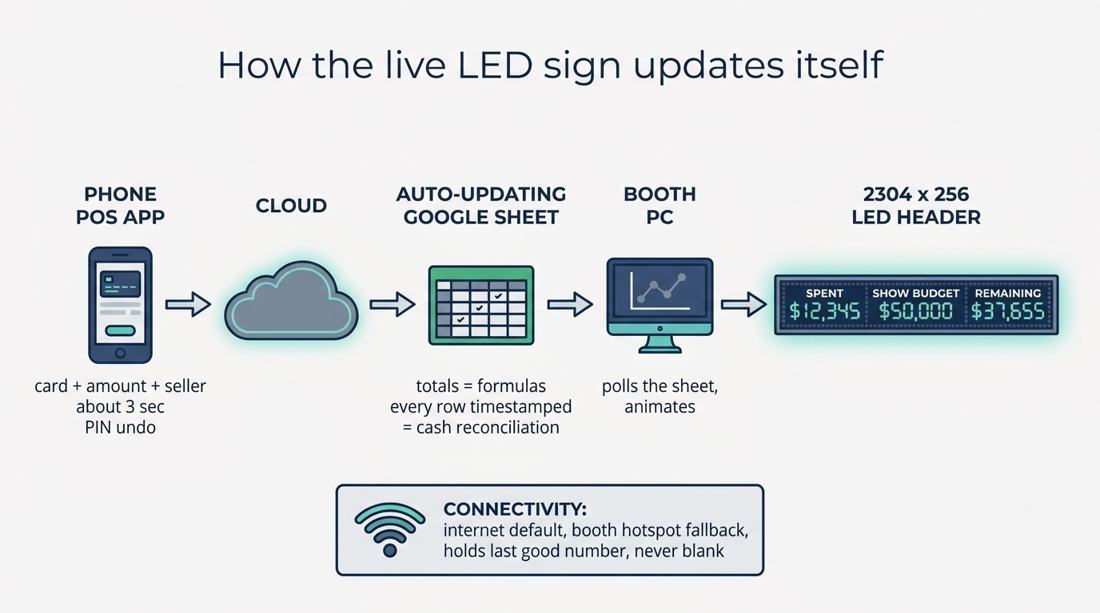
- Designed the data flow — phone entry → cloud → auto-updating Google Sheet → the booth PC polls and animates.
- Wrote the whole interactive demo — a web page rendered on the real grid, pixel-art sale animations, and synthesized sound — plus the POS phone flow, the auto-updating Google Sheet, and an ops dashboard.
- Deployed it, then produced the one-page visual and the WhatsApp brief for the client.
All of that, the same evening the quote arrived.
What did the human do?
The judgment — which is exactly where a person should spend their time:
- Chose the angles that make a crowd stop: the eye-stopper animations, the hourly giveaway, the sport-specific plays.
- Pushed on what the audience actually sees from across the aisle.
- Set the rules that protect the brand in public: only ever decrement on a confirmed payout so the number never jumps back up; plan the “$0 left” moment as theatre, not failure; never let the screen go blank.
- Owns the vendor conversation — the one precise resolution question that AI surfaced.
AI compressed the build. The human owned the decisions. That division is what “adding AI to your business” really means.
The old way vs. the AI-assisted way
| Old way | AI-assisted way | |
|---|---|---|
| Time | ~1–2 weeks of specs, design, dev, revisions | One evening — quote PDF to deployed demo |
| Cost | Several vendors billing separately | A fraction, because the build loop is compressed |
| Who’s involved | Developer + designer + integrator + PM | The owner’s judgment + AI doing the build |
| What you get | A quote and a timeline | A working, deployed demo you can show tonight |
| Risk caught | On the show floor | Before a pixel is built (the resolution gotcha) |
What does the business actually get from a live LED panel?
A trade-show LED panel that stops being a static logo and becomes a crowd magnet:
- A live countdown of cash left to spend, updating on every purchase.
- BIG BUY takeover moments, an hourly giveaway with a winning ticket, and top buy of the day with a pixel portrait of the seller.
- A purchase log that reconciles the cash automatically — every entry timestamped in the sheet.
- A plan that survives dead convention-centre Wi-Fi: a booth hotspot fallback, and the wall holds the last good number instead of going blank.
You can see the whole thing running — wall, phone, and sheet, with sound — in the live demo: live-budget-wall.netlify.app. (The numbers in it are demo data.)
“But we already have purchase-tracking software”
Then it’s even easier. If that software has an API, the panel connects straight to it. If it doesn’t, a 3-second phone entry per purchase feeds the same sheet. The reason both paths were on the table at all is that AI made each of them cheap enough to just try instead of scoping a project. That’s the shift: things that used to need a business case now need an evening.
FAQ
Can an LED panel at a conference or trade show show live, changing data?
Yes. An LED panel takes an HDMI feed like a monitor. Render a web page at the panel’s exact resolution, output it over HDMI, and feed the page from a live source (a Google Sheet, an API, a database). It updates itself — no one standing at the panel with a laptop.
Is “adding AI to my business” the same as adding a chatbot?
No. A chatbot is one narrow use. The bigger win is AI in the build loop — reading documents, deriving specs, writing and deploying working tools — so small teams can afford custom systems, like a live LED display, that used to be big-brand only.
What’s a real, non-hype example of AI for a small business?
This one: a live LED “cash budget” panel for a trade-show booth, built from a vendor PDF in one evening, updating itself from a Google Sheet. Concrete, deployed, and owned by the client’s own staff.
Did AI make the important decisions?
No — it made them fast to act on. The human chose the angles, set the public-facing rules, and owns the vendor relationship. AI did the reading, spec-deriving, coding, and deployment.
Do I need new software or a new LED wall to do this?
Not necessarily. If you already have panels booked with a vendor, this drives them; if your business software has an API, it connects; if not, a light phone entry does the job. The build adapts to what you already run.
How fast can this happen for us?
This build went from a PDF quote to a deployed demo in one evening. Yours depends on scope — but the loop from idea to working thing is dramatically shorter than the old vendor cycle.
What this means for your business
You don’t need to be a big brand to have the things big brands have. “Adding AI” isn’t buying a chatbot licence — it’s compressing the distance between “wouldn’t it be great if…” and a working thing you can show tonight. A small company can now afford a custom, live, self-updating LED display because AI collapsed the build cost.
Planning a trade show or conference and want your LED panels to actually do something? That’s exactly where we start. Tell us your show date, the panels or vendor you’re working with, and the one thing you wish the display could show — Verikal turns it into a live, tested build in a fraction of the old time and cost. We find where your business loses time or money and build the agent — or the system — that closes it. See what Verikal builds →, or book a free 30-minute discovery call and bring your show date.
Found a leak in here? Let’s find the bigger one.
Book a free 30-min call